1–3 business days (Dubai) | 3–5 business days (Other Emirates)
Returns:
14-day returns (conditions apply)
Product Overview
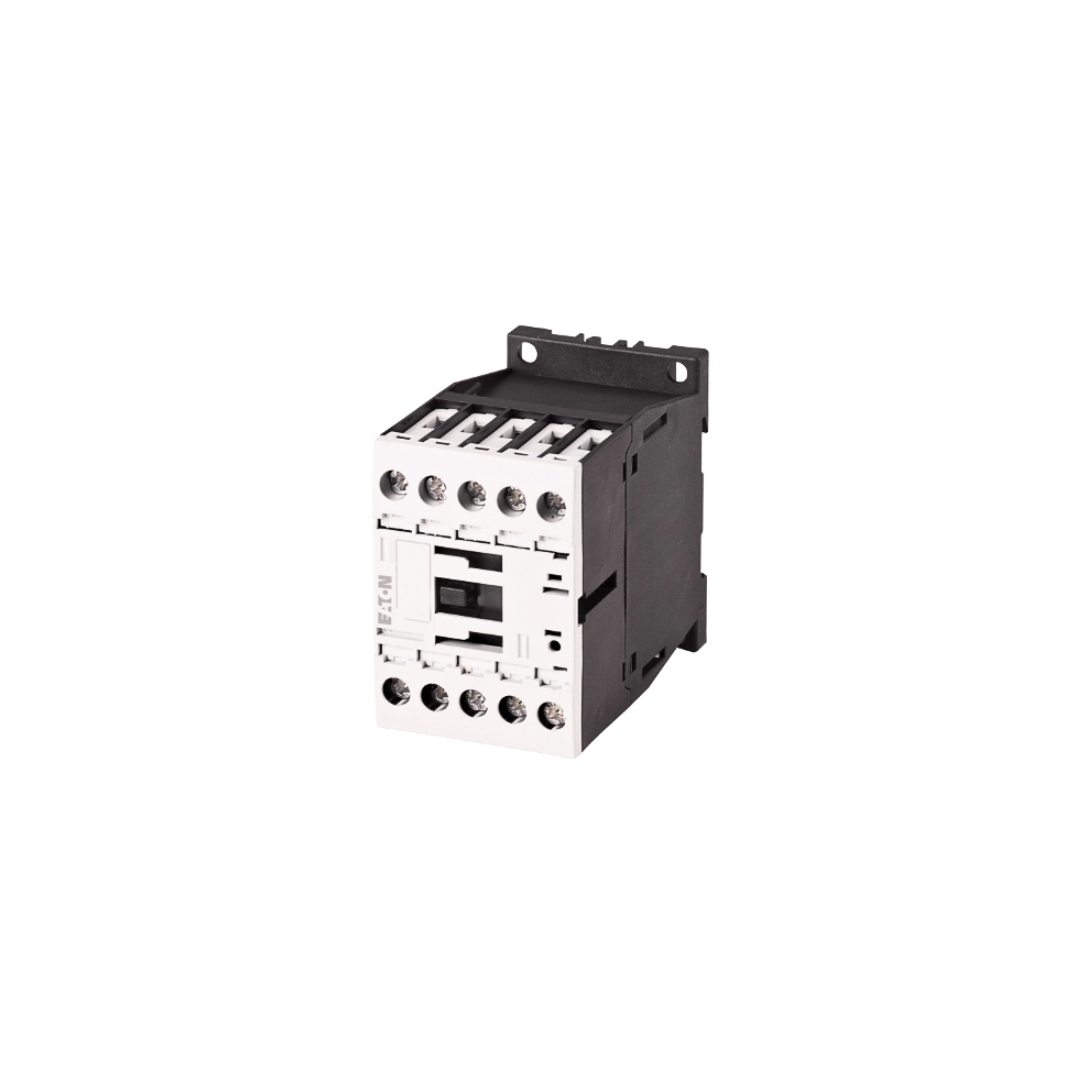
The EATON 4N/O (Four Normally Open) contactor relay designed for DC (Direct Current) current is an electromechanical switching device used to control electrical circuits that operate on DC power. It consists of four independent normally open (N/O) contacts, which means that when the relay is not energized, these contacts are open, and when the relay is energized, they close to establish an electrical connection. The relay coil is the primary component that controls the switching action of the contacts. When a DC current is applied to the coil, it generates a magnetic field, which attracts the movable armature or plunger within the relay. The 4N/O relay contains four sets of normally open contacts. Each set consists of two electrical terminals: a common terminal (C) and a normally open terminal (N/O). These contacts are used to establish or interrupt the flow of DC current in the controlled circuit. When the relay coil is not energized (no current flowing through it), the four sets of contacts are in their default state, which is open. In this state, there is no electrical connection between the common terminal (C) and the normally open terminal (N/O).
When a DC current is applied to the relay coil, the magnetic field attracts the movable armature, causing the four sets of contacts to close. In this energized state, the common terminal (C) is connected to the normally open terminal (N/O), completing the electrical circuit. Contactor relays are widely used due to their robustness, reliability, and ability to handle high currents and voltages. They play a crucial role in various industries where precise and efficient control of DC circuits is required.
Features
Length: The Contactor relay has 75 millimetre length.
Height: The Contactor relay has 68 millimetre height.
Width: The Contactor relay has 45 millimetre width.
Weight: The Contactor relay weighs 0.296 kilogram.
Stripping length: The Contactor relay has 10 mm stripping length.
Benefits
Electrical isolation: Contactor relays provide electrical isolation between the control circuit and the power circuit. This isolation ensures that the control circuit, which may have lower voltages and currents, remains unaffected by the higher currents and voltages in the power circuit.
High current and voltage handling: Contactor relays are designed to handle high currents and voltages, making them suitable for controlling heavy-duty electrical loads such as motors, solenoids, and lighting systems.
Robustness and reliability: These relays are built to withstand harsh operating conditions, including temperature variations, mechanical vibrations, and electrical surges, ensuring long-term reliability and stability.
Remote or automatic control: Contactor relays enable remote or automatic control of electrical circuits, making them suitable for automation applications. They can be easily integrated into control systems and programmed for specific operations.
Easy integration: Contactor relays have standardized dimensions and mounting options, making them easy to integrate into existing electrical systems or control panels.
Low power consumption: The control coil in a contactor relay typically requires low power to operate, which helps reduce energy consumption during its activation.
Minimal maintenance: Due to their durable construction and reliable operation, contactor relays require minimal maintenance once installed properly.
Fast switching speed: Contactor relays can switch quickly between the open and closed states, making them suitable for applications requiring rapid response times.
Safety features: Many contactor relays come with additional safety features like auxiliary contacts, which can be used for signaling or interlocking purposes to enhance the safety of the controlled system.
Versatility: Contactor relays are available in various configurations, including different contact arrangements (N/O, N/C, and changeover), coil voltages, and contact ratings, allowing them to be used in a wide range of applications across different industries.
Technical Specifications
The EATON 4N/O (Four Normally Open) contactor relay designed for DC (Direct Current) current is an electromechanical switching device used to control electrical circuits that operate on DC power. It consists of four independent normally open (N/O) contacts, which means that when the relay is not energized, these contacts are open, and when the relay is energized, they close to establish an electrical connection. The relay coil is the primary component that controls the switching action of the contacts. When a DC current is applied to the coil, it generates a magnetic field, which attracts the movable armature or plunger within the relay. The 4N/O relay contains four sets of normally open contacts. Each set consists of two electrical terminals: a common terminal (C) and a normally open terminal (N/O). These contacts are used to establish or interrupt the flow of DC current in the controlled circuit. When the relay coil is not energized (no current flowing through it), the four sets of contacts are in their default state, which is open. In this state, there is no electrical connection between the common terminal (C) and the normally open terminal (N/O).
When a DC current is applied to the relay coil, the magnetic field attracts the movable armature, causing the four sets of contacts to close. In this energized state, the common terminal (C) is connected to the normally open terminal (N/O), completing the electrical circuit. Contactor relays are widely used due to their robustness, reliability, and ability to handle high currents and voltages. They play a crucial role in various industries where precise and efficient control of DC circuits is required.