We’ve upgraded Alisouq for a faster, smoother experience
SKU: 036803 036804 036805 036806 036808 0368012 0368014 0368016
(incl. VAT)
loading...
Nuts with reduced load capacity Hexagon nuts with lower nominal height complying with the withdrawn DIN 985 standard cannot support test loads as per ISO 898-2 The strength class designation has two vertical bars added before and after the strength code to differentiate. DIN 985 has been replaced by 10511, 10512 and 7040 When the bolt-nut connection is established, the screw thread is secured by the plastic ring. The high level of friction created by the clamping forces between the thread profiles generates the locking torque necessary to maintain a part of the pre-load force. No damage to the thread surfaces Operating temperature range: -70 C to +120 C When using a nut and bolt of the same size, the difference between strength class I8I and I10I is a greater load capacity of approximately 40 % Notice DIN 985 has been withdrawn and replaced by ISO 10511. There is some limited similarity (thread M7, M18, M22, M27, M33 and threads with nominal diameter > M36 removed | Fine thread removed | Nut height changed | Width across flats changed for threads M10, M12 and M14 to 16, 18 and 21 mm | Strength classes changed to 04 and 05).
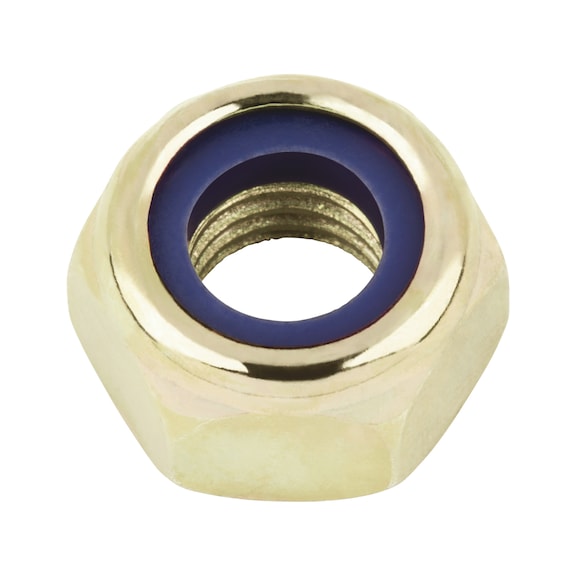
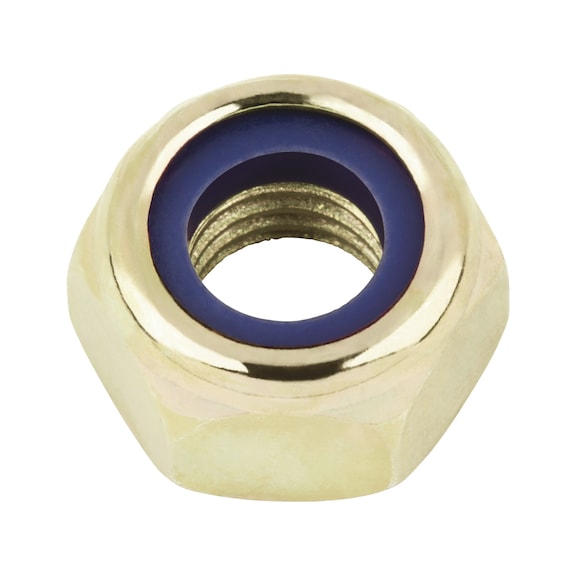
Hexagon nut, low profile, with clamping piece (non-metal insert) DIN 985, steel I8I, zinc-plated, yellow chromated (A2C/A3C) Standards: DIN 985 Material: Steel Surface: Zinc plated yellow RoHS-compliant: No Form: Low Locking device operating principle: Clamping part polyamide ring Locking function: Locking against loosening by clamping See product details Show similar products
Nuts with reduced load capacity Hexagon nuts with lower nominal height complying with the withdrawn DIN 985 standard cannot support test loads as per ISO 898-2 The strength class designation has two vertical bars added before and after the strength code to differentiate. DIN 985 has been replaced by 10511, 10512 and 7040 When the bolt-nut connection is established, the screw thread is secured by the plastic ring. The high level of friction created by the clamping forces between the thread profiles generates the locking torque necessary to maintain a part of the pre-load force. No damage to the thread surfaces Operating temperature range: -70 C to +120 C When using a nut and bolt of the same size, the difference between strength class I8I and I10I is a greater load capacity of approximately 40 % Notice DIN 985 has been withdrawn and replaced by ISO 10511. There is some limited similarity (thread M7, M18, M22, M27, M33 and threads with nominal diameter > M36 removed | Fine thread removed | Nut height changed | Width across flats changed for threads M10, M12 and M14 to 16, 18 and 21 mm | Strength classes changed to 04 and 05).